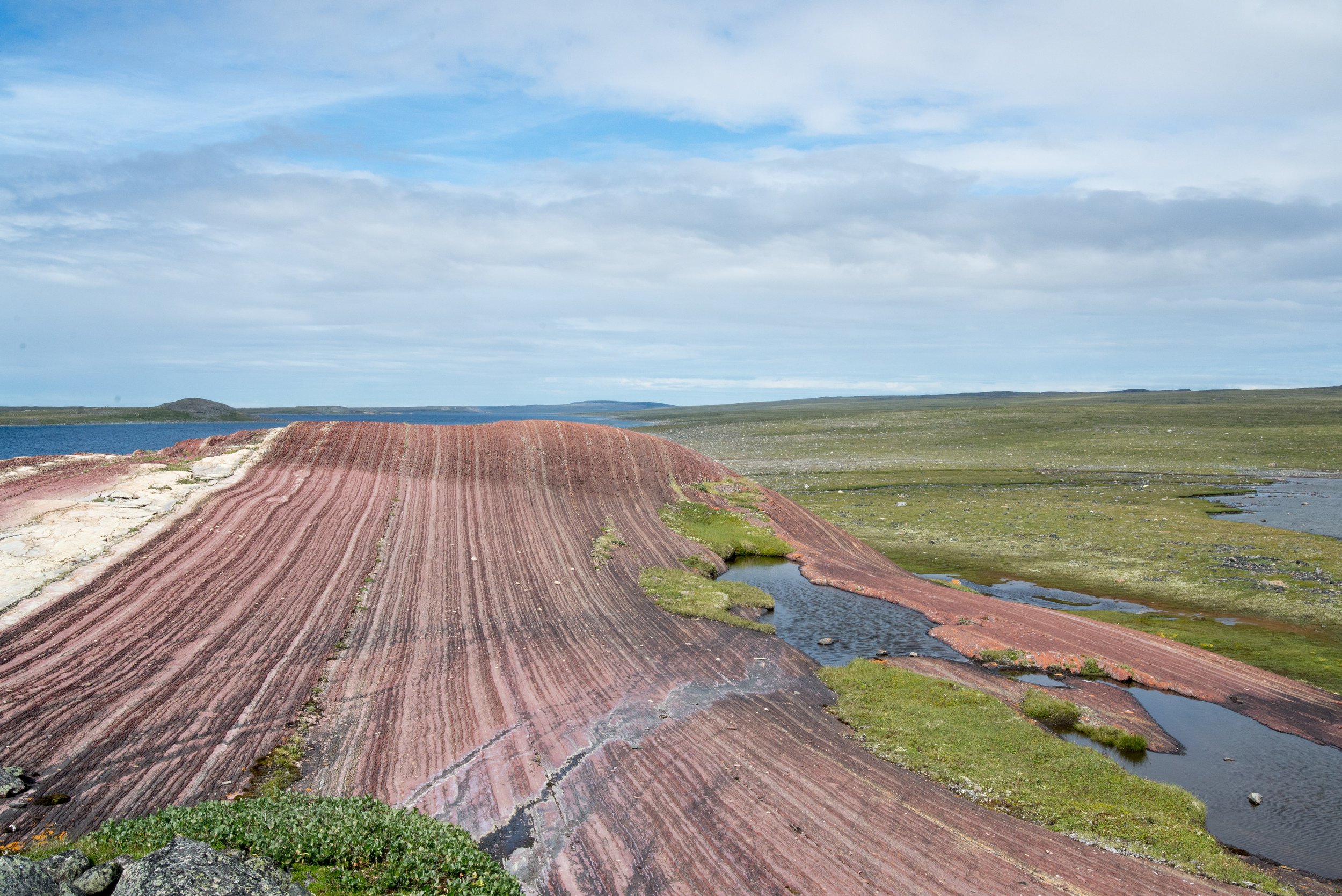
The ROSETTA Lab studies the evolution of Earth’s surface environments, primarily (but not exclusively) during the Precambrian. Broad research goals include:
Understanding how oxygen levels have changed through Earth history, especially in connection to the Great Oxidation Event and hypothesised ‘oxygen overshoot’
Improving understanding of Earth’s ancient carbon cycle, especially in connection to the Lomagundi-Jatuli carbon isotope excursion and the following Orosirian Period
Strengthening the geological framework for sedimentary basins around the Circum-Superior Belt through integrated sedimentology, stratigraphy, geochemistry, and geochronology
How did changes on Earth’s surface impact the evolution of life and the formation of critical mineral deposits like iron, uranium, graphite, manganese, and others?
Why ROSETTA Lab?
The Rosetta Stone is a large granodiorite slab, carved in 196 BC and rediscovered in 1799 AD. It carries the same passage three times: in Ancient Egyptian hieroglyphic and demotic scripts, as well as Ancient Greek. With this discovery, scholars were able to translate translate Ancient Egyptian hieroglyphs.
The work that the ROSETTA Lab carries out relies on information recorded in ancient rocks to reconstruct events whose details have been lost to time. Plus, it’s a rock, and we study rocks.